
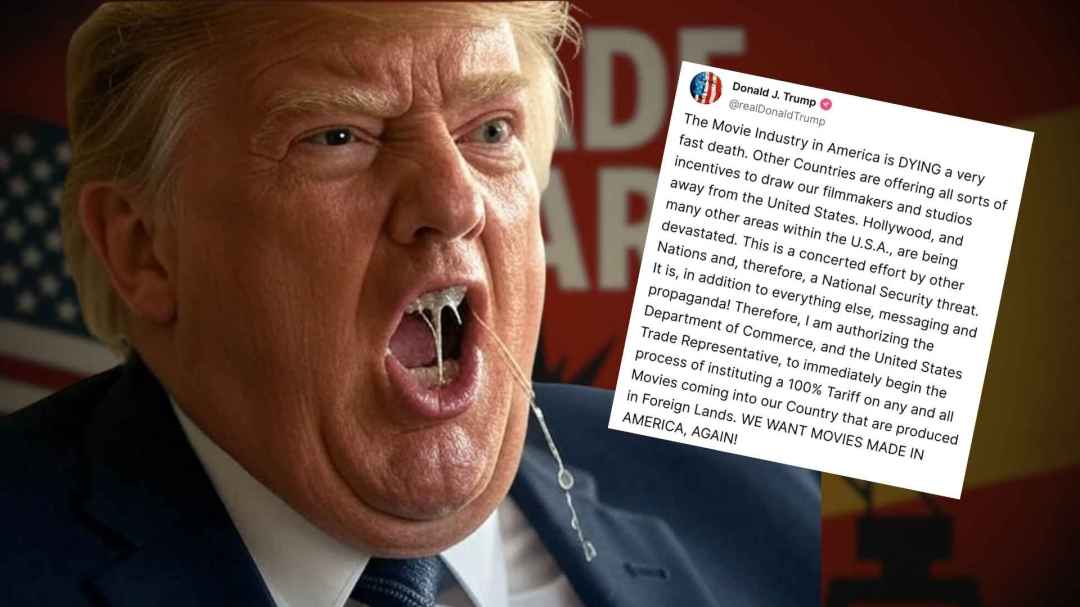
Donald Trump’s latest stunt in what economists are now calling the stupidest trade war of all time isn’t aimed at China’s factories or Europe’s carmakers. No, this time he’s coming for Hollywood—the one industry he’s always wanted to be part of but never truly belonged to.
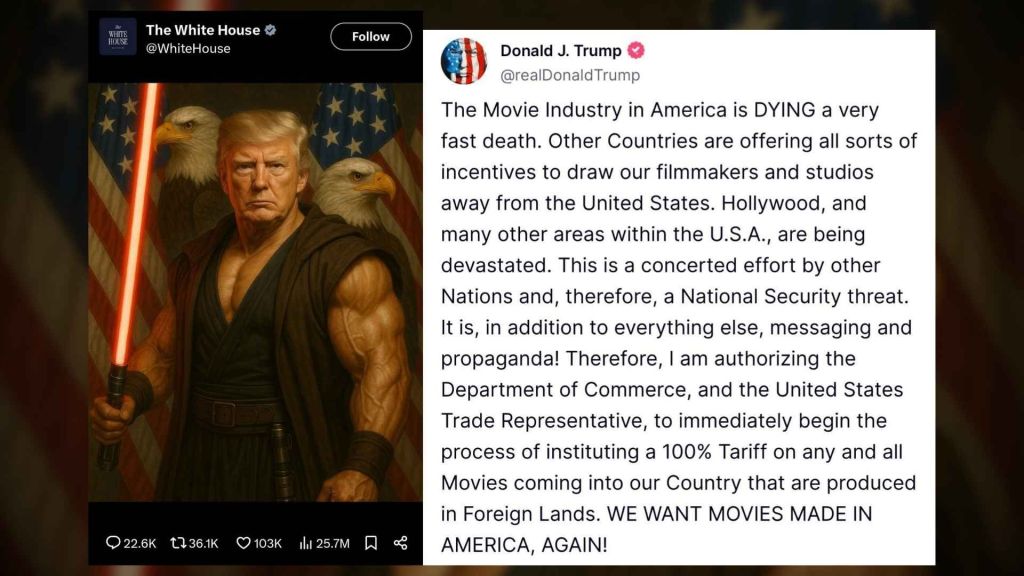
This morning, after Trump’s White House tweeted out an AI-generated image of him as a Sith Lord to celebrate Star Wars Day, he turned his attention to Hollywood—the place he’s always circled but never cracked.
In a Truth Social post that reads like a presidential tantrum disguised as policy, Trump announced a 100% tariff on all foreign-produced films entering the U.S. He framed it as a matter of national security—as if subtitled dramas and indie Korean thrillers were an existential threat to American sovereignty. In reality, it’s another flag-waving, logic-choking move in a trade war that’s already dragging down the economy. And now, apparently, it’s Hollywood’s turn to be collateral damage.
Let’s be honest: Trump has never been interested in fixing Hollywood. He’s wanted to own it. From obsessing over the Oscars to lobbing insults at actors on Twitter (a platform he still haunts thanks to Elon), Trump has always seen Hollywood as the cool kids’ table that wouldn’t give him a seat. So now that he’s back in power, he’s doing what any vindictive outsider would—he’s trying to burn the place down and call it patriotism.
Trump’s claim is that America is being economically undermined by other countries offering incentives to lure U.S. film productions overseas. Places like Canada, the UK, and Australia have long offered generous tax credits, cheaper crews, and streamlined production pipelines that make them attractive alternatives to California. Trump’s solution? Slap a 100% import tax on every movie made outside the U.S. and make it “not worth it” to produce abroad.
Except there’s one small problem: foreign films barely register at the U.S. box office.
Each year, maybe 100 foreign-language films get a theatrical release here. Maybe a dozen make more than a million dollars. Most don’t even crack half that. In raw numbers, they account for less than 1% of annual box office totals. So, while the policy may sound dramatic—and sure, it’ll gut a few arthouse distributors—it won’t bring in billions or meaningfully shift the economic engine of Hollywood.
But here’s the kicker: Trump’s not even targeting those films. He’s going after American productions that shoot overseas—like Marvel movies filmed in the UK or Canada to take advantage of tax credits and lower production costs. These aren’t foreign movies. They’re Hollywood films with international logistics. But nuance isn’t exactly Trump’s thing. In his mind, if a movie didn’t wrap in Burbank or Baton Rouge, it’s basically a French art film trying to kill the economy.
So instead of a smart fix for runaway production, what we get is another red-meat policy designed to stir up his base, punish blue-state industries, and pretend like complex global production pipelines can be solved with tariffs and chest-thumping.
If you’re looking for an actual foreign power limiting film access, look no further than China. For years, they’ve capped the number of foreign films allowed in the country to 34 revenue-sharing titles annually, most of them American blockbusters. They’ve edited content, delayed releases, and more recently, started cutting down even further. Hollywood plays nice because China’s box office is massive, and a Fast & Furious movie can make more in Shanghai than it does in Chicago. And when Trump raises tariffs on China? They cut more U.S. films out of their quota.
So, what we have now is something of a cultural standoff: China restricts our blockbusters, and we, in turn, propose tariffs on foreign imports—including indie dramas from France or Korean thrillers that might show up at Alamo Drafthouse. It’s retaliation without proportion. Symbolism over strategy.
Enter Jon Voight. Fresh off being appointed as one of Trump’s “Hollywood Ambassadors”—alongside Mel Gibson and Sylvester Stallone, because of course—Voight unveiled a new initiative this week aimed at “restoring the Golden Age of Hollywood.” His plan includes expanding California’s film and television tax credit from $330 million to $750 million per year, pushing for a revival of Section 181 to give producers faster write-offs, and offering federal support for job training and production infrastructure.
On the surface, it sounds… reasonable. Maybe even helpful. The film industry has taken real hits: COVID, labor strikes, the streaming collapse. Voight’s proposal addresses real issues that working filmmakers face—runaway productions, underfunded indie projects, a squeeze on middle-budget films. But peel back the curtain and it’s clear this is more than economic stimulus.
This is ideology wrapped in incentive.
Voight isn’t just acting as a concerned citizen; he’s been explicitly positioned as Trump’s eyes and ears in Hollywood. And his plan reads like a cultural reset button—one aimed at rewarding productions that align with the administration’s vision and punishing those that don’t. Want that sweet tax credit? Better be filming in the heartland, not Vancouver. Want federal support? Don’t count on it if your movie dares to criticize American institutions.
The message is clear: Hollywood has had its fun with globalist co-productions, streaming-first models, and award-winning international films. Now it’s time to bring it all back home—to the U.S. soundstages, red-state tax shelters, and Reagan-era patriotism.
But here’s the thing: you don’t make great movies by legislating loyalty. You don’t rebuild an industry by cutting it off from the rest of the world. And you certainly don’t revive American cinema by turning it into a MAGA-approved content farm.
Yes, the film industry needs help. Yes, we’ve lost ground to international competitors. And yes, there’s value in rebuilding the production infrastructure here at home. But this approach—scorched earth tariffs, political loyalty tests, and nostalgia-fueled nationalism—isn’t about saving cinema. It’s about controlling it.
And that’s a plot twist nobody asked for.

 Hollywood After Dark