
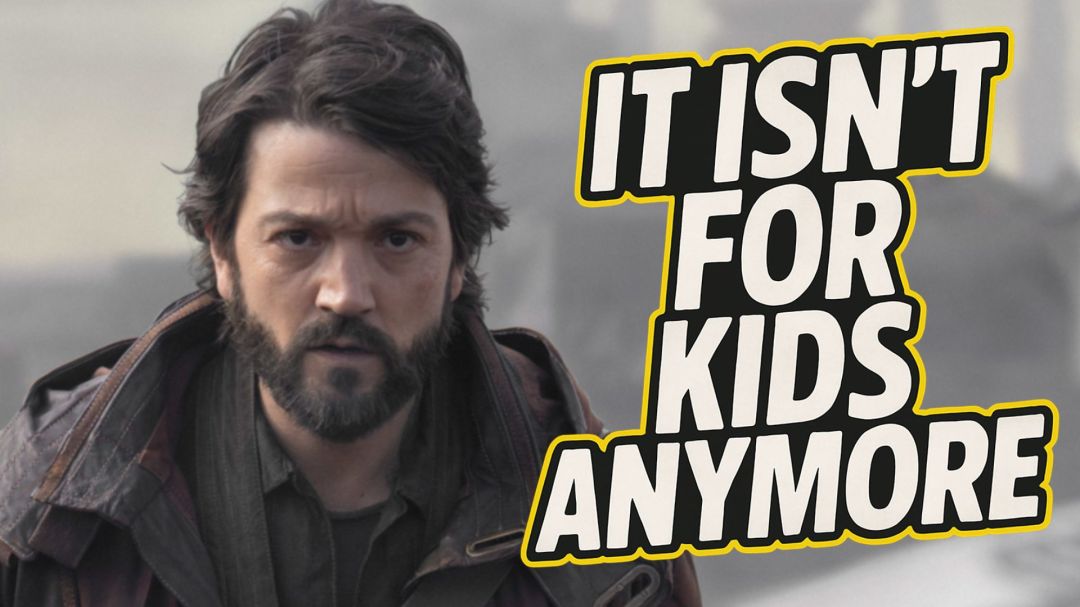
For a franchise built on toy sales, laser swords, and a Wookiee that can’t lose at chess, Star Wars sure grew up fast. Or maybe we did. Either way, something’s changed—and Andor is the proof.
Gone are the days when a new Star Wars meant nothing more than a two-hour spectacle where good guys wore beige, bad guys wore black, and nobody asked questions about supply chains, fascism, or prison labor. But then along comes Tony Gilroy’s Andor, which basically slammed the brakes on nostalgia, ripped off the fan-service paint job, and said, “Hey, what if Star Wars actually had something to say?”
This show isn’t for kids. And I don’t just mean that in the usual, “ooh it’s gritty and dark” kind of way. I mean it’s fundamentally not built for an audience that thinks Darth Vader is cool because he can choke people. Andor is for the generation that grew up with Star Wars, only to realize adulthood looks a lot more like the Empire than the Rebellion. It’s for people who know that revolutions are messy, bureaucracies are lethal, and sometimes the only way to fight evil is by becoming the exact kind of person you never thought you’d be.
I was a baby when Return of the Jedi came out. My mom took me to the theater, and I like to imagine that was the first time my tiny brain ever processed the concept of “cool.” But I didn’t really get it until years later. Not the space battles or Ewoks, but what it meant to stand up to something bigger than you, something that doesn’t care if you’re a farm boy or a princess or a smuggler with a soft spot. And now, decades later, I’ve got kids of my own. They love Grogu. They love the colors, the creatures, the comfort. And that’s fine. They’re supposed to. But I’m not watching Andor because I want comfort. I’m watching it because I want to feel something. Because I need to see a galaxy that reflects the one I live in—flawed, complicated, and terrifyingly real.
Andor gets that. It’s not about the Force. It’s not about chosen ones or magic bloodlines. It’s about people. People being crushed by the weight of an indifferent system. People being told to keep their heads down and stay in line. People being radicalized by grief, anger, and the slow, creeping realization that no one is coming to save them.
That’s not kid stuff. That’s the real shit.
And look, I’m not throwing shade at the rest of the franchise. There’s room for lightsaber duels and Skywalker melodrama. But Andor is something else entirely. It’s patient. It’s bleak. It’s a slow burn that doesn’t end with a space wizard saving the day—it ends with the understanding that salvation doesn’t come easy, and sometimes the only win you get is one more day alive. In other words, it’s not a story about hope. It’s a story about earning hope.
That’s what makes it brilliant.
I’ve watched enough Star Wars to know that people like to compartmentalize the saga. Original trilogy is for the purists. Prequels are for the apologists. Sequels are for… well, marketing. But Andor broke the mold because it didn’t give a shit about where it fit. It didn’t pander. It didn’t wink. It just told a story that needed to be told, and it did it without asking for your nostalgia as payment.
Which, honestly, is why it hit so hard.
There’s a scene where Kino Loy—played with gut-punch brilliance by Andy Serkis—realizes he’s never getting out of prison. No grand escape. No medal ceremony. Just the horrible, soul-shattering truth that the system was never built to let him go. And in that moment, Star Wars said more about oppression than anything the movies ever managed with stormtroopers and secret Death Stars.
That’s not just mature storytelling. That’s storytelling for people who’ve lived a little. People who’ve been laid off. Who’ve been lied to. Who’ve stood in a voting booth or a hospital hallway or an unemployment line and thought, “This whole damn thing is rigged, isn’t it?”
So yeah, Star Wars isn’t just for kids anymore. It probably never was. We just didn’t see it back then because we weren’t supposed to. We were too busy swinging plastic lightsabers and making pew-pew sounds to notice that the rebels were actually insurgents, the stormtroopers were just doing their jobs, and the Jedi Council was kind of full of shit.
Now we see it. And we’re ready for more.
Because if the Empire is still a metaphor, it sure as hell feels like a modern one. And Andor? That’s not escapism. That’s a mirror. A really well-lit, beautifully acted, nerve-jangling mirror.
And the wildest part? It’s still Star Wars. It’s just the version that doesn’t pull its punches.
Let the kids have Grogu. I’ve got bills, back pain, and a deep-seated mistrust of corporate hegemony. Andor speaks my language.

 Hollywood After Dark