
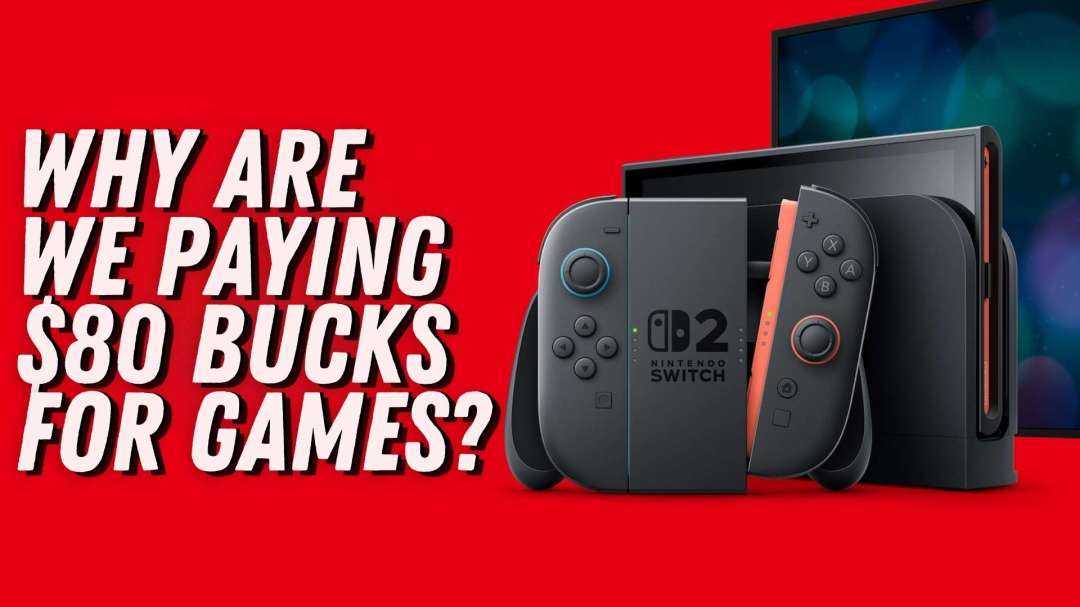
Eighty bucks for a video game. Sixty for a movie date. Thirty-five for a Blu-ray. That’s not hyperbole, that’s just what it costs now. And what’s wild is… nobody really seems to be freaking out about it. Maybe a grumble here, a meme there, but mostly? Just quiet acceptance. As if we all got the same unspoken memo: this is just how it is now.
Microsoft dropped the bombshell this week—starting this holiday season, first-party Xbox games are going to be $79.99 in the U.S. That’s digital or physical, doesn’t matter. No fancy “deluxe” edition required, that’s just base price now. Gears of War: E-Day, Fable, Clockwork Revolution, OD, the next Call of Duty—they’re all part of the new $80 club. And that’s not even the whole story. Consoles are jumping in price too. The Xbox Series X now costs $599.99. The Series S is $379.99. Controllers are up to $79.99. It’s across the board.
Microsoft says it’s about “market conditions” and “development costs,” which is corporate PR for “we think we can get away with it.” And they might be right. Because people will pay it. They always do. But that doesn’t mean we should ignore what it signals. Because here’s the thing—video games are the canary in the coal mine. They are the biggest, most profitable entertainment medium on the planet. And when prices go up in gaming, the rest of the entertainment industry watches closely. Games set the tone. Always have.
It’s already rippling. Movie theaters are quietly making the jump to premium pricing as the default. The national average ticket price just cracked $16.08. That’s average. Go to an IMAX in New York or L.A. and you’re paying over $23 for a single ticket. Throw in a date and a tub of popcorn, and you’re flirting with $60 for two hours in a sticky recliner. That’s not even luxury anymore—that’s just Saturday night.

AMC tried to push it even further with their “Sightline” pricing model—charging more for middle seats and less for the front row. But after a brief trial, they scrapped the idea in mid-2023, admitting it made their prices less competitive and didn’t sway customers to the cheaper seats. So, for now, we’re spared the airline-style pricing at the movies. But the fact that they even tried tells you where their heads are at.
Then there’s physical media, which feels like it’s being slow-cooked into extinction. What used to be a $19.99 Blu-ray you could grab at Target is now a $34.99 boutique release you have to order online. The collector’s editions? Forty bucks. Fifty. More, if it’s got a slipcover and a bonus disc. Best Buy bailed out of the market entirely. Target shoved everything into online-only territory. And with fewer big retailers competing, prices are free to float upward. Meanwhile, a 25% tariff on discs manufactured in Mexico is quietly gutting margins. The result? Fewer releases, lower print runs, and higher prices for everyone still hanging on.
Let’s be honest—physical media has become niche not because the demand vanished, but because the companies decided it wasn’t worth chasing volume anymore. It’s easier to cater to a smaller, passionate audience willing to pay a premium. So now we get fewer options, and the ones we do get cost more. We’re told it’s about “preserving the format,” but it feels more like preserving the margins.
All of this adds up to a bigger question: when did we collectively decide that entertainment is supposed to be expensive?
Because somewhere along the line, we started accepting that paying more for less was just the cost of keeping up. $80 games, $60 date nights, $40 Blu-rays—this has become the new normal. And the arguments in favor of it always boil down to the same two things: inflation and innovation. That it costs more to make this stuff now. That audiences are getting more for their money. But are we? Really?
Games launch broken half the time. Movies get pulled from streaming libraries like they’re being erased from existence. Physical discs ship in eco-cases so flimsy you could fold them in half like a tortilla. Where’s the added value?
The truth is, this is less about rising costs and more about shifting expectations. We’re being conditioned to see these price hikes as inevitable, when they’re anything but. This is a test balloon. A slow, careful push to see how far consumers can bend before they snap. And so far, we haven’t snapped. We’ve shrugged. Maybe left a YouTube comment. Maybe fired off a sarcastic tweet. But mostly, we’ve complied.
And that’s dangerous. Because if $80 is the new standard for games, what’s stopping $90? What happens when streaming services decide $30 for a digital rental is fair? When every theatrical ticket comes with a surcharge for “immersive sound” or “enhanced seating”?
This isn’t about being nostalgic for the old days. It’s about recognizing the direction we’re heading and asking whether it’s sustainable—or even desirable. Because if we don’t push back, if we don’t at least question it, then we’re not just customers anymore. We’re marks.
So yeah, maybe it’s just ten more bucks here, five more there. But it adds up. And the more we normalize it, the easier it gets for these companies to keep pushing the ceiling higher and higher. Until one day, you’re paying $150 for a collector’s edition of a movie that doesn’t even come with a disc, just a digital code and a commemorative coaster.
And maybe, by then, we’ll look back and wonder when exactly we decided that was okay.

 Hollywood After Dark