
Let’s be honest—Tarantino has a point. The movie industry has changed drastically, and not always for the better. The pandemic didn’t just disrupt theaters; it flipped the entire system on its head. Streaming exploded, theaters shut down, and audiences got used to watching the latest releases from their couches. For Tarantino, the year 2019—when Once Upon a Time in Hollywood came out—feels like a last hurrah. That was the year of Parasite, Little Women, The Irishman. And then, boom: the pandemic hit, and the movie world was never quite the same.
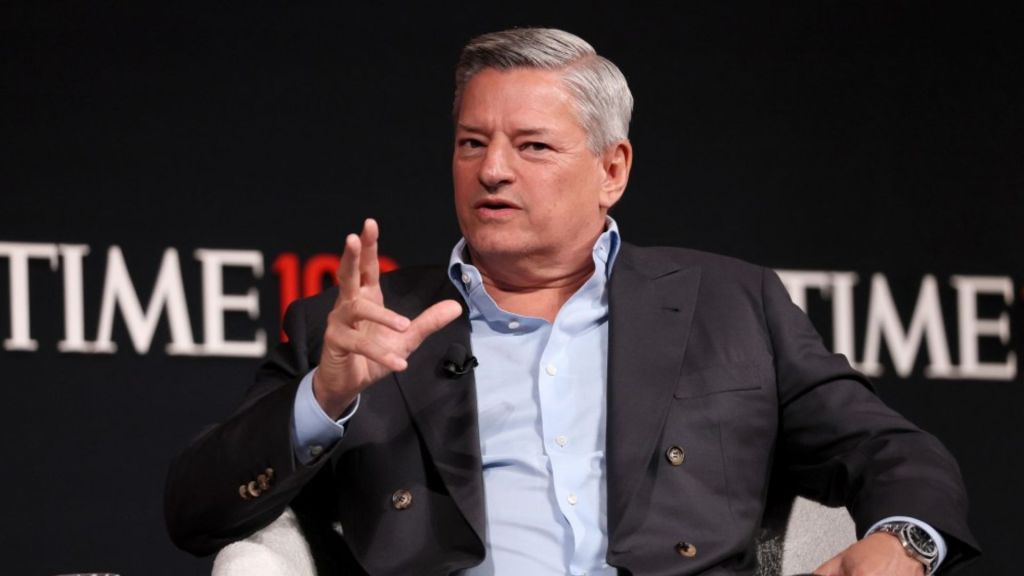
Which brings us to Ted Sarandos, co-CEO of Netflix, who recently declared at the TIME100 Summit that movie theaters are “an outmoded idea for most people” and that Netflix is “saving Hollywood.” That quote sent film Twitter into a frenzy, and you can practically hear projectionists across the country grinding their teeth. But here’s the uncomfortable part—he’s not wrong. He’s just leaving out the part where Netflix helped break Hollywood before they started saving it.
Let’s not forget the origin story. Netflix was born from spite—specifically, over a late fee. Co-founder Reed Hastings got dinged $40 for returning Apollo 13 late to Blockbuster. That pain turned into the revolutionary DVD-by-mail service, which turned into streaming, which turned into global dominance. It’s a satisfying underdog story, right up until you remember that Blockbuster had the chance to buy Netflix for $50 million in 2000. They passed. Netflix didn’t just win—they razed the entire landscape. Blockbuster, Hollywood Video, every neighborhood rental shop? Gone. And with them went a massive part of Hollywood’s safety net.
See, physical media wasn’t just a fun way to collect movies—it was a financial parachute. Studios could take theatrical risks because they knew they had DVD sales waiting in the wings. Some films made more on home video than they ever did in theaters. It was a second life, a second chance. That revenue stream helped sustain mid-budget movies, cult classics, even total box office flops. Once streaming became king, that entire fallback plan vanished.
Netflix didn’t stop there. They changed how people thought about movie ownership. Why drop $25 on a Blu-ray when you could pay $10 a month for endless content? It didn’t take long for audiences to adapt. Ownership was out. Access was in. And just like that, the consumer relationship to film changed forever.
But back to Sarandos. He’s not wrong when he says Netflix is saving Hollywood. They are. They’ve just rebuilt it in their own image. As of early 2025, Netflix has over 301 million global subscribers. Even at an estimated average of $10–11 per month, that’s easily over $3 billion per month in revenue. Some subscribers pay more—up to $24.99 for premium tiers in the U.S. Add in ad-supported plans, regional pricing, and scale it across 240+ countries, and the platform is printing cash at a level that makes movie studios salivate. It’s not a platform—it’s an empire.
So when Netflix drops $320 million on The Electric State, they’re not sweating whether it would’ve bombed in theaters. They’ve already made their money. It’s not about ticket sales—it’s about retention. And that gives them the power to bankroll movies that probably wouldn’t survive under the traditional model.
And it’s not just Netflix. Disney+ clocks in around 124 million subs globally, and Amazon Prime Video—riding on top of Amazon’s ecosystem—has over 200 million users. These platforms are Hollywood now. They bankroll the projects, control the release strategies, and dominate the audience’s attention. In a weird twist, the streaming giants became the lifeline they once undermined.

But it’s not just about economics—it’s about experience. The other night, I saw Dogma in theaters as part of the Resurrection Tour. Kevin Smith was there, the crowd was hyped, people clapped and cheered and hooted like it was 1999. And it reminded me of why theaters matter. It felt like church. The Cathedral of Cinema. But that kind of experience? It’s rare.
I went with a friend I hadn’t seen in a couple years. He’s a movie guy, always has been. But when I asked how he watches most stuff these days, he shrugged and said, “I just stay home.” And how can you blame him? Movie tickets in my area are around $12 for a 10 a.m. showing right now, but last summer when Deadpool & Wolverine dropped, they were charging $19.25 for the same slot. And with Superman, Fantastic Four, and Jurassic World: Rebirth all on deck, there’s no reason to think they won’t crank those prices up again. Add in concessions and parking, and you’re flirting with $50 just to see a movie you’re not even sure you’ll love. For a lot of people, the couch wins by default.
And the numbers don’t lie—physical media is down 22% year-over-year, with sales dropping below $1 billion annually. It’s become boutique, collector-focused. The mainstream abandoned it. Streaming didn’t just beat it—it rewired how we engage with movies. Everything is instant, disposable, bingeable. A movie drops on Friday and disappears by Monday because we’ve already moved on to the next thing. That loss of permanence? That’s the cost of convenience.
So when Ted Sarandos talks about saving Hollywood, he’s not wrong. He’s just being selective. Netflix may be the bandage, but they were also the blade. They dismantled the old system, replaced it with a new one, and now they’re standing over the wreckage with a triumphant smirk.
But maybe the solution isn’t choosing between streaming and theaters. Maybe it’s making room for both. Because as magical as last night was, that kind of communal movie experience isn’t practical for every film or every viewer. Streaming gives us access. Theaters give us reverence. And maybe—if we’re lucky—we can have a world where both survive.
Even if we have to pay $19.25 at 10 in the morning to do it.

 Hollywood After Dark