
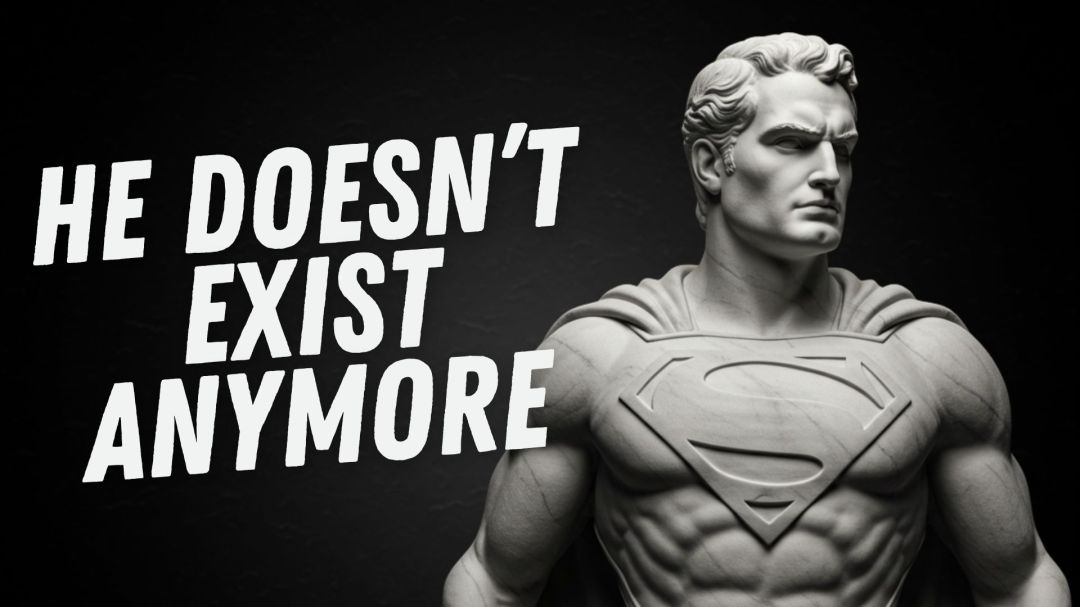
On Superman Day 2025, I’d like to remind you there is no true Superman.
That’s not a hot take. It’s just the truth. A hard truth for some people, especially the ones who treat Clark Kent like a sacred cow of American pop culture. But once you look past the cape, the tights, and the warm glow of nostalgia, it becomes obvious. The Superman people think they know—the one who’s always smiling, always doing the right thing, always saving the day—isn’t real. He’s changed so much over the years, he’s barely the same character his creators came up with back in 1938. Honestly, Jerry Siegel and Joe Shuster probably wouldn’t recognize him today.
And the wild part? It’s not because people don’t care. It’s because they care too much. They’ve built him up, added to him, stretched his mythology until he broke free from the page and became something else entirely. What started as a Depression-era champion for the working class turned into a walking sun god. He used to leap over buildings. Now he fuses with stars. He’s flown so far beyond human limits that his power level isn’t just high—it’s over 9000. And we just keep letting it happen.
That’s not evolution. That’s full-blown transcendence.
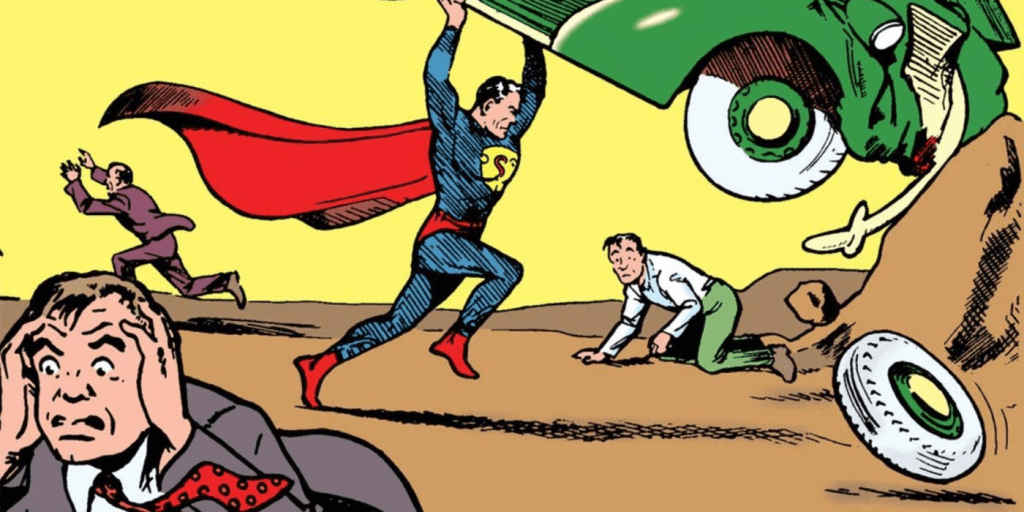
In the beginning, Superman was a blue-collar bruiser. A power fantasy for the average person. A guy who fought slumlords, socked abusive husbands, and ripped the roofs off corrupt businesses. He was angry. Sharp. Political. And he couldn’t even fly. That came later, when animators decided it looked better than a glorified hop. From there, the powers snowballed. Heat vision, freeze breath, time travel. The guy became so strong the writers had to invent a glowing space rock just to give him a challenge. They turned him into a god, then tried to keep telling stories like he was still a man.
That’s the problem with superheroes. They don’t stay the same. They can’t. They’re always shifting, always adapting, always mutating to fit the era they exist in. Superman is the purest example. He was the first superhero, and he’s had to survive every trend since. The Cold War, the space race, post-9/11 cynicism, Snyderverse bleakness. Every decade files off a piece and adds a new one. He’s not a character anymore. He’s a construction site. A never-ending game of narrative telephone.
It’s no wonder fans can’t agree on which version of him is “real.” To some, it’s Christopher Reeve floating above Metropolis, grinning like the human embodiment of hope. For others, it’s Henry Cavill, brooding through grayscale rubble. Some point to All-Star Superman as the pinnacle, where he literally becomes a celestial force of nature. Others swear by Kingdom Come, Red Son, or even Injustice. Every iteration has its believers. Its disciples. It’s less fandom and more theology. Everyone’s praying to the Superman that made them feel something.
Which makes sense. Superman, at this point, functions like religious canon. You’ve got your Old Testament Superman, who leaps tall buildings and lays righteous smackdowns on evil landlords. Then there’s New Testament Superman, who floats gently, forgives often, and bleeds symbolism. Then come the apocryphal texts—the Elseworlds stories and alternate timelines. Each writer interprets the myth differently, each continuity treats the previous one as half-true. It’s not a character. It’s a doctrine.
The parallels go deeper. The Abrahamic religions—Judaism, Christianity, and Islam—all build on each other’s foundation while evolving into something distinct. Judaism lays the groundwork. Christianity reframes it through the lens of a personal savior. Islam claims continuity while asserting itself as the final revelation. Superman’s myth follows the same path. Each new version draws from the last but insists on being definitive. Pre-Crisis. Post-Crisis. New 52. Rebirth. The character is fractured across time, each piece shaped by the needs of its generation.
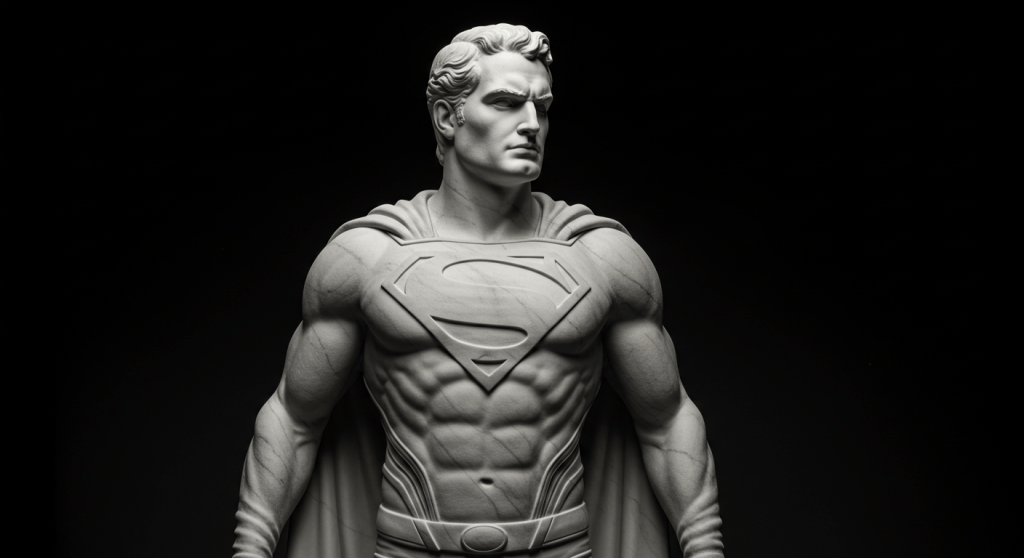
But here’s where it really diverges. Religious myths eventually freeze. Roman gods stopped evolving after the Empire collapsed. Their stories, once living and breathing, became static—preserved in art and literature, no longer changed by belief. Superman never got that rest. He became intellectual property. A brand. A corporate mascot. The stories kept going because they had to. Because quarterly earnings don’t stop for legacy.
So the mythology stretched. It bent. It broke. And somewhere in that process, Superman lost what made him compelling in the first place. Not his powers—his perspective. He was never supposed to be untouchable. He was supposed to be good, yes, but vulnerable. Grounded. Human, in the ways that mattered. But the stronger he became, the harder it was to tell stories that actually meant something. The writers tried to make his “humanity” the weakness. The fans started saying “He represents the best of us” as if it solved anything. But really, those are just canned responses to a deeper problem: he’s too perfect to care about, and too big to bring down.
Meanwhile, Superman’s cultural relevance has been slipping. Batman outsells him. Spider-Man outshines him. Marvel turned characters like Rocket Raccoon and Groot into household names while Superman stood off to the side, like a prom king whose crown never showed up. DC tried to revive him with Man of Steel, then again with Justice League, and again with Superman & Lois. Now James Gunn is stepping in with Superman—just Superman—armed with an army of cameos and a Hail Mary plan to launch a new universe. And sure, Gunn turned a group of cosmic misfits into a billion-dollar franchise before. If anyone can pull it off, maybe it’s him.
But it also might be too late.
Because the problem isn’t just that Superman hasn’t had a good movie in a while. The problem is that nobody knows who he is anymore. Not really. He’s a dozen contradictory versions of himself, pulled in every direction, stretched across time and tone-deaf studio mandates. He’s a blank slate people write their ideals onto. A symbol that sells better than it speaks. A myth that’s still alive, but only because no one’s figured out how to end the story.
There is no true Superman. There never was.
There’s only the one you remember. The one that meant something to you once. The one that smiled, or soared, or told you it was okay to believe in something bigger. That version is just as real as any other. But don’t let anyone tell you he’s the only one.
Because Superman, like every god we’ve ever invented, belongs to the people telling the story.
And right now, nobody can agree on what the story is.

 Hollywood After Dark