
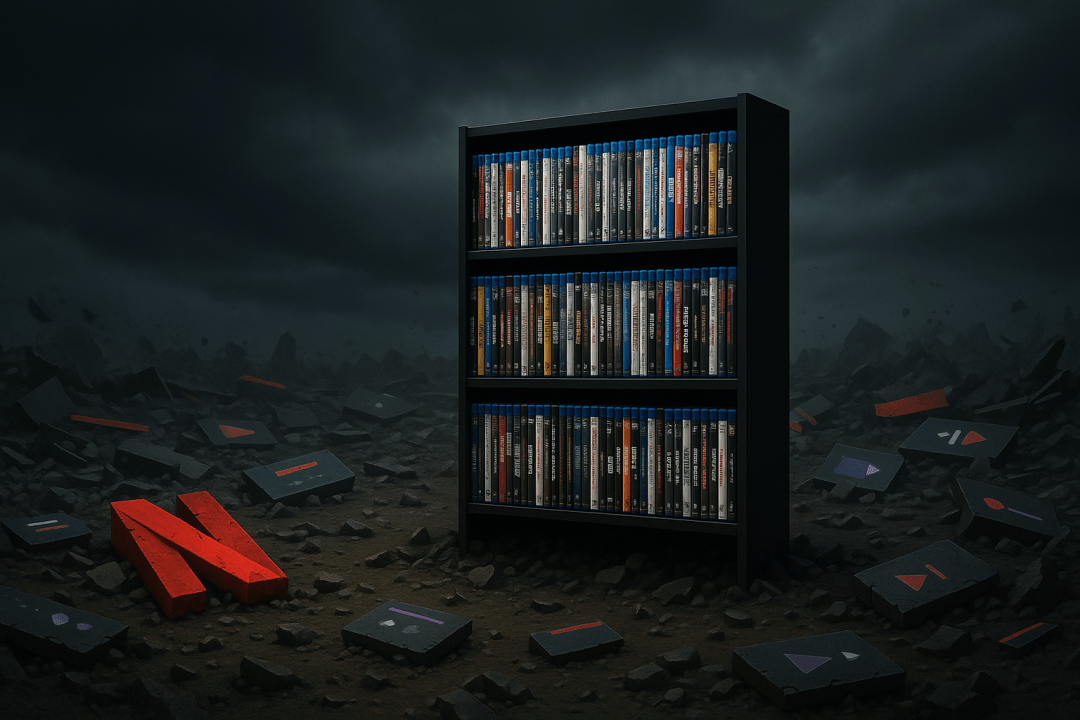
Netflix just posted another strong quarter. Subscriptions are up. Revenue’s solid. Wall Street’s smiling. But if you’re a fan of physical media, it’s the same old punchline: you’re still getting nothing. No discs. No 4K releases. No shelf presence. Netflix is the guy who shows up to a potluck with a bag of chips and then eats everyone else’s lasagna.
In 2025, Netflix still refuses to release most of its original films on physical media. And we’re not talking about background filler here — we’re talking Glass Onion, The Killer, Leave the World Behind. Critically acclaimed, award-winning films that exist only as streaming data. No disc, no download, no ownership. Just access — temporary, fragile, conditional access. Netflix doesn’t want you to own anything. It wants you to rent your relationship with its content forever, one monthly charge at a time.
This isn’t just about cost or convenience. It’s ideology. If you can’t buy it, you can’t lend it, archive it, or pass it on. You can only keep paying for access until one day — maybe tomorrow, maybe next year — it disappears. Netflix wants to be your entire film library, and also your eraser. It’s not entertainment. It’s a digital memory hole.
Now, Apple hasn’t exactly emerged as the savior of physical formats either. But they’ve at least cracked the door. Severance: Season One got a Blu-ray release in late 2024. Not 4K. Not Dolby Vision. But it existed — released by a distribution partner, not directly by Apple. Wolfwalkers also saw a Blu-ray release a few years back, but Apple was only the U.S. distributor, not the producer. The Tragedy of Macbeth? There’s an international Blu-ray out there, but no U.S. disc, and nothing in 4K. So while some Apple content has made it to disc, it’s been rare, scattered, and always handled by someone else.
Netflix, to be fair, has made the occasional exception. The Irishman got a Criterion Blu-ray in 2020. It wasn’t 4K, but it was treated with respect: director-approved transfer, proper supplements, and actual care. But that was five years ago. Since then, silence. No Power of the Dog. No Rebel Moon. No White Noise. Just vanishing originals that increasingly feel disposable.
Meanwhile, physical media itself has shifted. It’s no longer the mainstream format it used to be. In 2024, U.S. disc sales dropped below $1 billion for the first time, down 23% from the year before. But the story under the headline is more interesting. While DVDs and standard Blu-rays continue to decline, 4K Ultra HD has found a second wind — not with the general public, but with passionate collectors. People who want more than just the movie. They want context. Permanence. Art.
Boutique labels like Vinegar Syndrome, Arrow Video, Second Sight, Shout Factory, and Criterion aren’t just putting out movies — they’re preserving them. Curating them. Celebrating them. They’re offering restored transfers, thoughtful essays, commentary tracks, fold-out posters, booklets, reversible covers, and in some cases, versions of films that don’t exist anywhere else.
It’s physical media redefined. Not mass-market junk, but archival-grade cinema.
Look at what happened with Tombstone. Sony’s 4K SteelBook release of the film sold out almost instantly following Val Kilmer’s passing. Amazon? Gone. Walmart? Low stock. Zavvi? Wiped clean. And this wasn’t a fluke. Fans wanted to own the film — to hold it, rewatch it, honor it. Sony took notice. According to Bill Hunt from The Digital Bits, they’re already prepping a second pressing. That kind of response matters. It tells studios there’s a market worth serving — one that values quality over convenience.
Of course, the downside is cost. A standard 4K disc that used to be $24.99 now regularly sits closer to $35 or $40. Special editions climb higher. Boutique box sets can hit triple digits. And once a title goes out of print? Good luck. The aftermarket is a collector’s warzone, with prices that rival concert tickets. It’s become a luxury hobby, no question — but the passion hasn’t faded. If anything, it’s intensified.
Because here’s the thing: digital content is temporary. It’s governed by contracts, algorithms, compression, and corporate priorities. One month it’s there. The next month it’s gone. If streaming is fast food, physical media is a carefully cooked meal. One fills you up in the moment. The other stays with you.
And that’s why physical media still matters. Because in a world where streamers are more than willing to erase their own history, physical media is the last line of defense from the digital memory hole.
It’s not nostalgia. It’s preservation. It’s about control, quality, and ownership. About having a shelf that doesn’t change based on what a studio decides to pull, tweak, or bury. It’s the right to revisit, rewatch, and remember — on your terms, not theirs.
Streaming is here to stay. That’s fine. But we’ve seen what happens when convenience is the only goal. Libraries shrink. Context disappears. Art is treated like content. Physical media pushes back against that. It says, “This mattered. This deserves to be held.”
So stream it, sure. Watch it on your phone. Enjoy it on your couch. But if a film means something to you — if it hits you deep, if it says something real — buy the disc.
Because tomorrow’s “disposable” content might be today’s masterpiece.
And when the algorithm forgets, your shelf will remember.

 Hollywood After Dark