
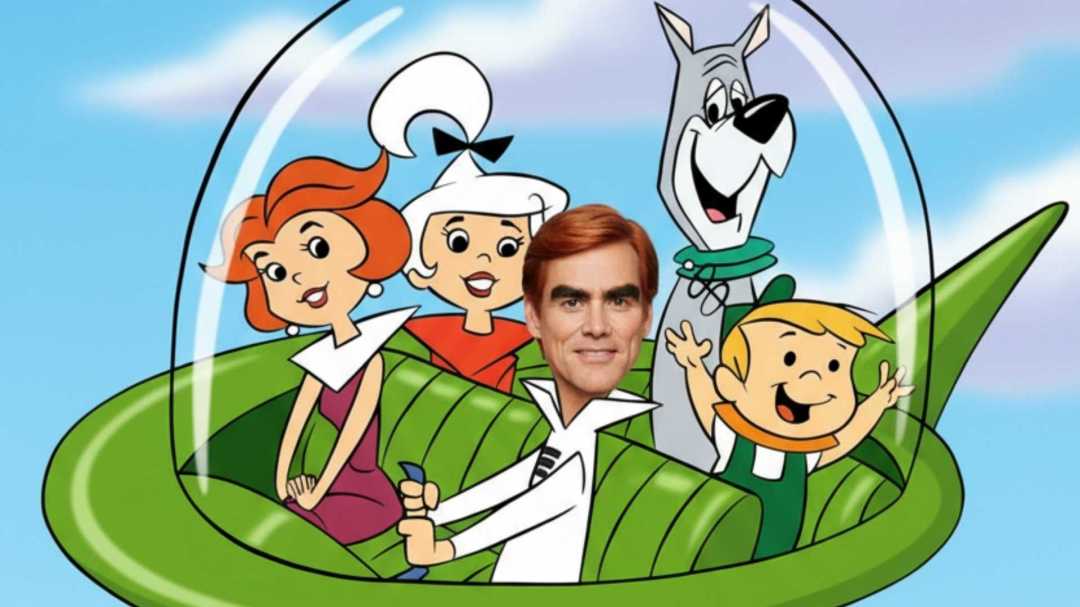
Jim Carrey might soon be flying a space car to work. According to The Wrap, Warner Bros. is developing a live-action Jetsons reboot with Colin Trevorrow—yes, the Jurassic World guy—set to direct. It’s early, no deals signed, but even the rumor feels strange. The Jetsons premiered in 1962—over sixty years ago—and the brand hasn’t meant anything to anyone under fifty for at least three decades. The show hasn’t been relevant since Jetsons: The Movie limped to theaters in 1990 and vanished without a ripple. So what’s the play here? Who’s this movie for?
That’s not a rhetorical question. Because the audience who grew up with The Jetsons isn’t exactly packing theaters anymore, and the generations after them don’t have any emotional connection to George, Jane, Judy, Elroy, or Rosie. They know the names maybe, but only as cultural wallpaper—retro future kitsch that exists somewhere between a mid-century ad for kitchen appliances and a pop-art emoji. The original series lasted twenty-four episodes, a single season cut short by low ratings. It only survived because reruns filled Saturday-morning slots for years. It was never a phenomenon like The Flintstones. It was a curiosity. An artifact. A cartoon for people who thought automation would be adorable.
And maybe that’s exactly why Warner wants it. The Jetsons represent a clean, plastic optimism that modern life can’t find anymore. The 1960s version of the future was bright, simple, and mechanical—no pollution, no politics, no poverty, just conveyor belts and sky-high condos. It was the dream of capitalism without consequence. But that future never arrived. We didn’t get jetpacks; we got burnout and bandwidth throttling. Automation didn’t save us; it just made us tired in new ways. So if this movie simply replays that fantasy, it’s dead on arrival. A hollow echo of a world that never existed.
What it could be is something more ambitious. Instead of turning George Jetson into another broken relic—another Luke Skywalker or Indiana Jones worn down by time—it could re-embrace the idea of possibility. Hollywood loves dragging its heroes through the mud: the hermit, the cynic, the man who’s lost faith in his own myth. It’s a formula that works because redemption arcs sell. But with The Jetsons, that tone would collapse the whole premise. This isn’t a story that needs to “find itself” in the ashes of failure. It’s supposed to be the shiny absurdity of what might come next. A Jetsons movie shouldn’t open with George depressed on his couch; it should blast off with him believing that the world can still get better.
The template already exists—Disney’s Meet the Robinsons did it almost twenty years ago. That movie captured the same spirit The Jetsons once had: goofy, heartfelt futurism built on creativity and family. Its closing motto, taken from Walt Disney himself, said it all: “Keep moving forward.” That’s the emotional core missing from most nostalgia plays today. We don’t need another requiem for lost dreams. We need something that reminds people it’s still okay to dream in the first place.
But then there’s the 2025 wrinkle: AI. If Trevorrow and Warner lean into artificial intelligence to build this world—to literally have machines generate a vision of a mechanized tomorrow—it could turn the whole thing into self-aware satire. A future built by algorithms about a world run by machines. That’s the kind of meta weirdness that might actually work. Let the imagery feel uncanny, let the colors glitch, let it look like a simulation trying to remember what optimism used to be. That would at least make The Jetsons relevant again—not as a comfort blanket, but as a mirror held up to our tech-drunk culture.
Still, that would require guts. And Hollywood isn’t exactly running on creative bravery right now. They’re chasing recognition, not reinvention. Nostalgia is safer than novelty. Reboots can be budgeted, marketed, and data-tested. Familiar IP is the last security blanket an industry terrified of risk can cling to. So The Jetsons might not be a bold new beginning. It might just be another plastic memory dug up and polished for an opening weekend and a few think-pieces.
But imagine, for a moment, that it isn’t. Imagine a version that doesn’t treat the future like a punch line or a casualty of cynicism. Imagine a Jetsons movie that’s funny, vibrant, and unapologetically hopeful—a film that sees the absurdity of modern life and still believes humanity can build something better. That would be worth making. That would be worth seeing.
Because if The Jetsons are coming back just to tell us how far we’ve fallen, we don’t need it. But if they’re coming back to remind us that we can still look up—maybe we finally deserve that future they promised.

 Hollywood After Dark