
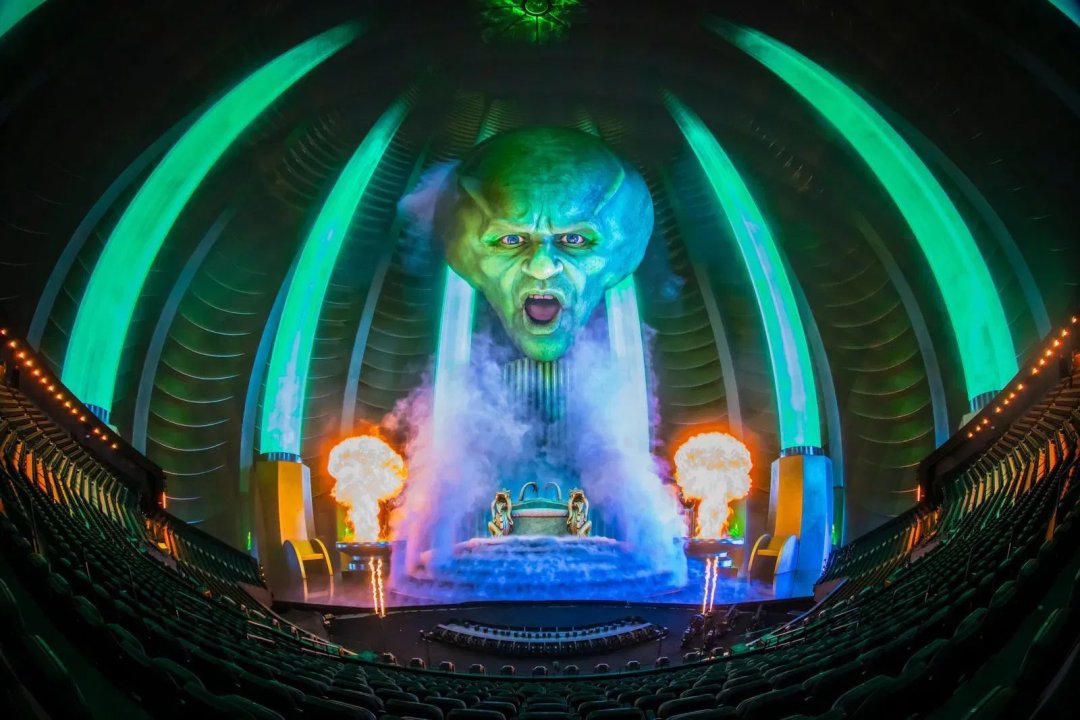
The Wizard of Oz at the Las Vegas Sphere is the kind of thing people swore would never happen. A film from 1939, ripped out of its 4×3 box, stretched across a 16K dome, run through AI like it’s a science experiment, and blasted into your skull with 167,000 speakers. Add wind, snow, rumbling seats, the smell of a poppy field, and suddenly you’re not just watching Oz—you’re trapped inside it. It’s cinema as spectacle, a full-body trip that feels less like a screening and more like stepping into a hallucination with a price tag.
That price tag is part of the problem. Tickets run from about $114 to nearly $400. This isn’t “let’s take the kids to the movies.” It’s a luxury attraction, an event folded into the Vegas tourist machine. Families who made the original Oz a generational tradition aren’t casually flying in to spend half a paycheck on it. That exclusivity already fuels a lot of the criticism, but let’s not pretend the backlash is only about money.
For the anti-AI crowd, this production is blood in the water. They hate the idea of AI in art, period. To them, this Sphere project is proof that technology is a parasite, leeching the soul out of cinema. And they’re not being subtle. You’ve got critics calling the visuals uncanny, robotic, lifeless—like the movie’s been sanitized and repackaged for tech bros. But let’s be honest: most of these people didn’t walk into the Sphere with open minds. They wanted it to fail. They came ready to tweet about how “AI ruined Oz” before Dorothy even left Kansas.
The truth is somewhere in between. Yes, the AI work isn’t perfect. Some sequences feel stretched thin, some faces dip into the uncanny valley, and you can tell it’s a first draft of what the tech can do. But that’s the point—it’s a first draft. The Sphere’s effects teams are literally updating the film in real time, patching it like a video game. The rough edges aren’t proof that AI is useless; they’re proof that it’s evolving. We’ve already seen AI jump from the “Will Smith eating spaghetti nightmare” era to nearly photoreal recreations in the span of a couple years. Anyone betting against it now is just betting on being left behind.
And here’s another thing the critics won’t tell you: those shaky cell phone clips floating around online aren’t proof of failure either. People are filming a curved, 16K dome through a flat phone lens. Of course it looks distorted. Of course it looks off. You can’t shrink a stadium-sized screen down to an iPhone and expect it to translate. The Sphere isn’t something you can judge from a TikTok video. It’s something you have to see with your own eyes, in person, to understand. That’s part of what makes it different—and part of why it scares the hell out of the skeptics.
And despite all the nitpicking, the audience numbers don’t lie. Over 120,000 tickets sold by August, with projections topping 200,000 before the run ends in March 2026. The Sphere’s making $110 million in Q4 alone. Every weekend show is packed. Families might grumble about the cost, but people are still handing over their money. If AI was truly “killing cinema,” it wouldn’t be doing record-breaking box office inside a dome in the desert.
Hollywood is watching, and they’re not subtle either. If Oz makes this kind of money, studios will line up their catalogs for Sphere treatment. Not every movie deserves it—some will crash and burn just like the 3D conversions from a decade ago—but others will thrive. Imagine Cameron dropping Avatar into this dome. Imagine Spielberg’s Jurassic Park with the T. rex roaring across 16K, shaking the floor under your feet. Done right, those experiences wouldn’t just silence the critics; they’d make them look irrelevant.
And that’s the real story here. The critics aren’t afraid of bad AI—they’re afraid of good AI. They know the second the tech stops looking clunky, their whole argument collapses. You can’t whine about “robots killing art” when people are lining up around the block to be blown away. So the tactic is to jump on every imperfection, inflate every flaw, and try to kill the idea in the cradle. They’ve done it before. They’ll keep doing it. But history doesn’t favor the Luddites, and it won’t this time either.
I’ll admit, the Sphere launch feels rushed. They should’ve polished it longer, hit the audience with something bulletproof, and left the haters gasping. Instead, they went live with a version that feels experimental, and that gives ammo to the people rooting against it. But I’m not writing it off. Far from it. I’m flying down from Seattle to Vegas to see it myself before the run ends. Because for all its flaws, this is the future. Messy, expensive, not fully formed—but still the future.
And here’s the bottom line: the people sneering the loudest aren’t cinephiles who still care enough to buy physical media. They’re the ones who already gave up on theaters, who stream half a movie on Netflix while doomscrolling on their phone and then declare cinema dead. They want everyone else stuck in the same rut—flat screens, flat sound, flat experiences—because that’s all they know. Meanwhile, the Sphere is a glimpse of what’s next. Not the end of movies, but the next leap forward.
And when the technology gets sharper, when the rough edges vanish, those critics will be left exactly where they belong: at home, on the couch, insisting nothing new is possible while the rest of us are already halfway down the yellow brick road.

 Hollywood After Dark